India’s No. 1 Online Admission Portal Apply Now
India’s No. 1 Online Admission Portal Apply Now

The healthcare education system in Nepal needs to overcome hurdles. It persists in developing creative solutions to address the healthcare requirements of its population. This article delves into the factors that influence Nepal's approach.
Medical education in Nepal has been shaped by the country's geography and limited resources. With few doctors serving a dispersed rural population across mountainous terrain, Nepal has had to adapt its medical training to prepare doctors for remote practice.
Some key facts about medical education in Nepal:
Nepal's approach focuses on increasing access, quality, and relevance to treat patients in remote Himalayan villages.
The most common medical degree is the Bachelor of Medicine and Bachelor of Surgery (MBBS):
Besides the standard MBBS, Nepal offers some specialized degrees:
These equip students with competencies to address community health needs. Graduates can also pursue MD/MS degrees for specialization.
Nepal's outcome-based MBBS curriculum has distinct components:
Pre-Clinical Foundation
The first 2 years deliver core fundamentals:
Clinical Rotations
The next 3 years involve rotations in:
Rural and Community Focus
Specialized training prepares for rural practice:
Competency Development
Internship
This curriculum prepares graduates for remote mountain medicine.
Nepal uses varied pedagogies in medical schools:
However, specialized technology and simulation still need to be improved, especially in remote mountain regions, due to infrastructure constraints across the challenging terrain.
Nepal's medical schools grapple with considerable challenges:
Inadequate Resources
Difficult Access
Language Disparities
Student Hardships
Quality Issues
Nepal is working to reform the medical curriculum and teaching methods:
These innovations aim to prepare doctors better while increasing retention.
Looking ahead, Nepal may modernize medical education by:
Please visit our page MBBS In Nepal to know more details.
Conclusion
Nepal has a unique approach to medical education shaped by geographical and social needs within communities. By balancing rigorous foundations with adaptability and ingenuity, Nepal's medical schools strive to overcome challenges and supply rural regions with skilled, dedicated physicians. The future lies in blending time-tested medicine fundamentals with targeted innovations to serve the Nepali people.
No Comments Found

The Directorate of Medical Education & Research (DME), Chennai has released an important notification (No.01/SCS1(1)/2026 dated 27 April 2026) regarding document preparation for UG Medical and Dental Admissions 2026–27.If you are planning for MBBS or BDS admission through NEET UG 2026 in....
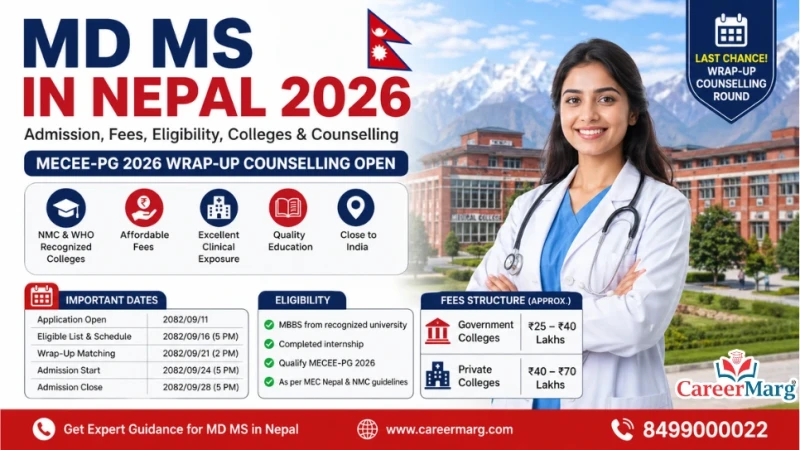
MD MS in Nepal 2026 admission is conducted through the MECEE-PG entrance exam by the Medical Education Commission. Candidates with an MBBS degree + completed internship must qualify MECEE-PG, participate in counselling, and secure a seat via merit-based matching. Total fees typically....

If you dream of becoming a doctor but are worried about the high private MBBS fees in India, MBBS in Bangladesh can be one of the best affordable options for Indian students in 2026–27. Every year, thousands of students choose to....

Students looking for MBBS admission in Bangladesh now have an exciting and trusted opportunity. CareerMarg, a leading medical admission guidance platform, is now the Authorized Partner of Anwer Khan Modern Medical College, Bangladesh, helping Indian students secure admission with authentic....

Latest Update: SAARC MBBS Admission Bangladesh 2025–26 (Official Notice)The Directorate General of Medical Education (DGME), Bangladesh has officially released the SAARC quota MBBS/BDS admission list for the 2025–26 academic session.According to the official office orders dated April 2026, multiple foreign....
 Request a call back
 Login
Login



 Apply Online

